Wood acoustic panels: micro-perforated or grooved? The guide
Micro-perforated or grooved wood acoustic panels? Both αw 0.90, class A; rWood Micro to 1.00 with mineral wool. Build-up, veneers, fire class, lead time.
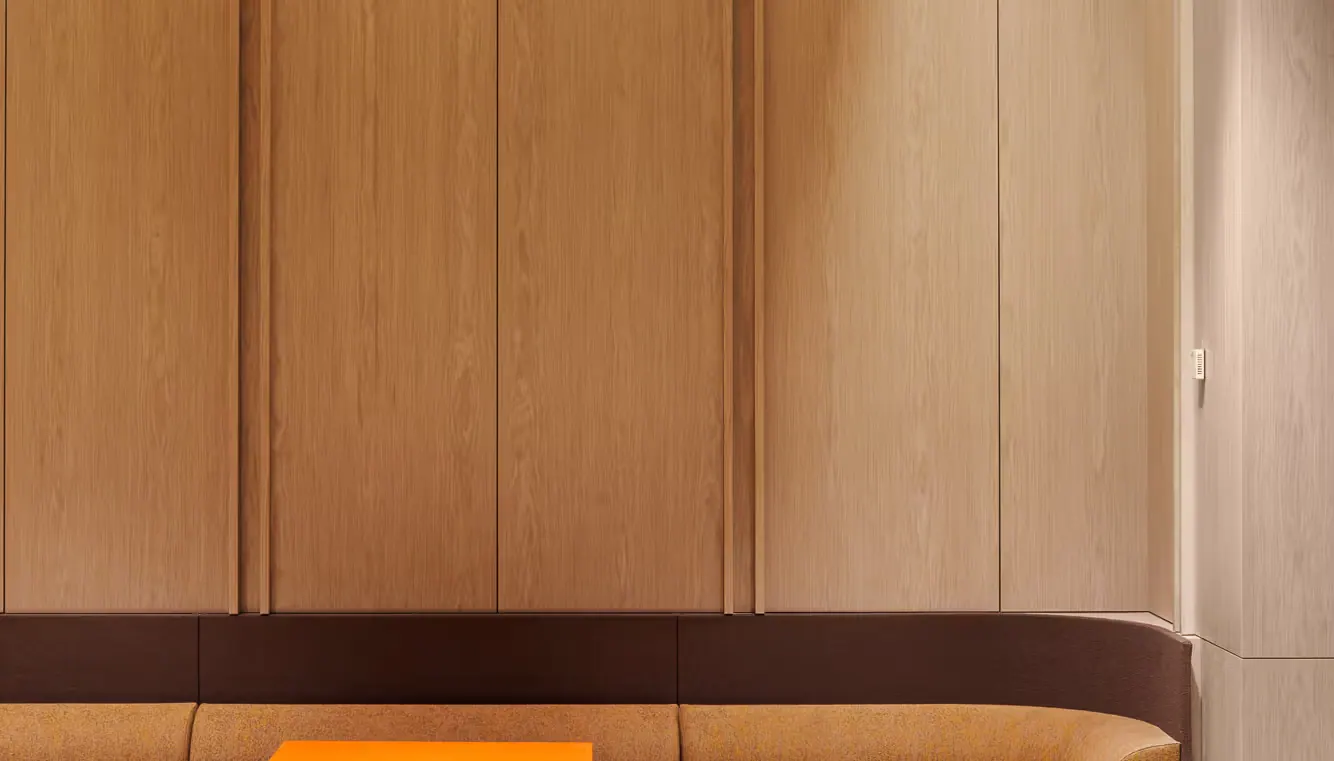
Micro-perforated and grooved wood acoustic panels absorb equally well: rWood Groove and rWood Micro both reach αw 0.90, class A to ISO 11654, and rWood Micro climbs to 1.00 with 50 mm mineral wool in the cavity behind it. So the choice comes down to build-up, look, fire class, lead time and budget. This guide sets out the figures for rWood Groove (grooved) and rWood Micro (micro-perforated), works through a Sabine example and ends with a decision table.
How grooved and micro-perforated panels absorb
Both belong to our wood acoustic panels: an FSC-certified A-grade veneer on an MDF core with an absorbent layer behind it. The wood is the face; the openings in that face and whatever lies behind the panel do the work. What separates the two is how the surface is opened and how the panel is built up.
Grooved (rWood Groove). Veneered MDF lamellas sit on a 3 mm felt of recycled PET; 15 mm grooves open the surface across the whole plank. Sound meets the felt in the grooves, enters it and loses its energy there. The panel therefore brings its own absorber: αw 0.90 to ISO 11654, class A (measured to EN ISO 354).
Micro-perforated (rWood Micro). The surface stays almost closed; only the fine perforation (holes from 0.5 mm across, in four densities up to 2 mm) leads sound into the fire-retardant MDF core with its sound chambers and into the acoustic fleece on the back. That gives the same αw 0.90, class A, and with 50 mm mineral wool in the cavity the value rises to αw 1.00. The figures depend on perforation density, cavity depth and the absorber behind the panel.
The deciding question: what sits behind the panel?
Anyone comparing micro-perforated with grooved is really comparing two build-ups. rWood Groove carries its absorber with it, the 3 mm rPET felt on its back, and is fixed tongue-and-groove on battens or glued straight to the substrate; on battens, the cavity behind can take an extra absorber. rWood Micro hangs on a concealed clip system on aluminium rails, tool-free, always with a cavity behind it, into which mineral wool can go. Three absorbers come into question for that cavity:
- Acoustic felt: the slim option when the build-up must stay shallow.
- rPET panel: made entirely from recycled PET, classified B-s1,d0 (white, grey, black) or B-s2,d0 (other colours) to EN 13501-1, cut on site with a knife or saw; its 12 mm sheet measures αw 0.25 flat on the wall and 1.00 over a 50 mm cavity with 50 mm stone wool, so the cavity decides.
- Mineral wool: the usual choice when a framed cavity is planned anyway; behind rWood Micro, 50 mm of it lifts the value to αw 1.00.
Both builds sit in class A; an absorber in the cavity adds reserve, up to αw 1.00 for rWood Micro. What remains is build depth, look and fire safety; check the exact requirement with your acoustician.
Worked example: a 56 m³ meeting room
A meeting room of 5 × 4 m with a 2.8 m ceiling holds 56 m³. Carpet tiles, six upholstered chairs, one glass wall; measured reverberation time 0.9 s. For the target we take the German standard DIN 18041 as our reference method: it files meeting rooms under group A3 (teaching/communication), where T = 0.32 · lg(V) − 0.17 s. UK offices look to BS 8233 and open-plan floors to ISO 22955; check the exact requirement with your acoustician.
T = 0.32 × lg(56) − 0.17 = 0.32 × 1.75 − 0.17 = 0.56 − 0.17 = 0.39 s
Sabine's formula, A = 0.161 × V / T, then gives the absorption needed:
| Calculation | Result | |
|---|---|---|
| Present absorption | 0.161 × 56 ÷ 0.9 | 10.0 m² Sabine |
| Absorption at 0.39 s | 0.161 × 56 ÷ 0.39 | 23.1 m² Sabine |
| Shortfall | 23.1 − 10.0 | 13.1 m² Sabine |
With rWood Groove or rWood Micro (both αw 0.90) that is 13.1 ÷ 0.90 = 14.6 m² of panels: the long wall opposite the screen (5 × 2.8 = 14.0 m²) plus a 0.6 m² strip on the end wall behind the speakers. Choose rWood Micro with 50 mm mineral wool in the cavity (αw 1.00) and 13.1 m² is enough; the long wall alone then does it.
Panels lower the reverberation of the room, but the call that still carries across an open-plan floor is not a job for panels; it is a job for a phone booth. Our Solo Flex starts at €4,118.75 excl. VAT, with installation by our team at €1,245 and transport within mainland Europe at €500, both excl. VAT.
Look and interior: a rhythm of lines or a calm wood surface
Grooved means visible rhythm. The grooves divide the wall into lines and read as an acoustic wall from across the room. In reception areas, restaurants and meeting rooms that is the classic; rWood Groove comes in five stock veneers and any veneer to order, finished in penetrating oil or lacquer.
Micro-perforated means calm. From two metres away rWood Micro looks like a closed veneer surface; only up close do you see the perforation. That is the choice for rooms where the wood should read as one plane (boardrooms, law firms, assembly halls, lecture theatres) or where the acoustic panels must run flush with doors and built-in cupboards. Its eight stock veneers come from Europe, Scandinavia and North America, with any veneer, stain and finish to order.
In both ranges we work with FSC-certified veneers only (certificate C191539). And the answer is often not either/or: grooved on the wall that defines the room, micro-perforated on the surfaces that should recede.
Fire safety: B-s1,d0 for rWood Micro
Schools, public offices and assembly buildings usually make the EN 13501-1 reaction-to-fire class a hard requirement. rWood Micro on its fire-retardant MDF core is classified B-s1,d0: limited contribution to fire, little smoke (s1), no flaming droplets (d0). So the micro-perforated build meets that requirement as standard. Formaldehyde class E1 applies to both ranges.
For rWood Groove the core decides: B-s1,d0 on the FR MDF core, D-s2,d2 on the standard MDF core; the rPET felt backing is B-s1,d0. Any extra absorber in the cavity belongs in the fire assessment too. The class your project needs follows from the building regulations and the use, so check the exact requirement with your acoustician and fire engineer.
Lead time, price and origin
Lead time hangs on the veneer. For rWood Micro, ex works:
- Stock veneers: 3–4 weeks.
- Veneers outside the stock programme and custom work: 6–8 weeks.
For rWood Groove the lead time is subject to stock; we confirm it on order. Veneer samples are free for both.
Re-Sound is a brand of Stretch Group; the rWood panels come from our own plant in Częstochowa (Poland), the textile range from Beveren-Waas (Belgium). At the end of their life we take panels back free of charge from Belgium, the Netherlands, France, Germany and Luxembourg; elsewhere the scheme does not apply. See sustainability.
The price per m² is set by quotation, excl. VAT, and depends on build, veneer, absorber and quantity. Veneered wood is our premium product; anyone who wants to spend less on the same area combines wood on the feature wall with rPET panels everywhere else. Send us your square metres via contact or find a dealer near you.
Decision table: when grooved, when micro-perforated
| Criterion | rWood Groove (grooved) | rWood Micro (micro-perforated) |
|---|---|---|
| Absorption αw (ISO 11654) | 0.90, class A, with its own 3 mm rPET felt on the back | 0.90, class A; up to 1.00 with 50 mm mineral wool in the cavity |
| NRC | not published | not published |
| Build-up and fixing | veneer on MDF lamellas over rPET felt; tongue-and-groove on battens or glued; cavity on battens can take felt, an rPET panel or mineral wool | veneer on an FR MDF core with sound chambers and fleece; concealed clips on aluminium rails; cavity with optional mineral wool |
| Reaction to fire (EN 13501-1) | B-s1,d0 on the FR MDF core, D-s2,d2 on standard MDF | B-s1,d0 (FR MDF core) |
| Look | visible grooves, rhythm of lines | almost closed wood surface |
| Veneer | FSC-certified only | FSC-certified only |
| Lead time, stock veneer | subject to stock, confirmed on order | 3–4 weeks |
| Lead time, veneer outside the stock programme | subject to stock, confirmed on order | 6–8 weeks |
And as a quick decision:
| Your situation | Recommendation |
|---|---|
| Shallow build-up, glued straight to the substrate | rWood Groove |
| Calm wood surface, flush with doors and joinery | rWood Micro |
| B-s1,d0 in a school, public office or assembly building | rWood Micro, or rWood Groove on the FR MDF core |
| A framed cavity is planned anyway | either; rWood Micro with 50 mm mineral wool up to αw 1.00 |
| Shortest lead time | rWood Micro in a stock veneer (3–4 weeks); rWood Groove subject to stock |
| Tight budget over a large area | wood on the feature wall, rPET panels everywhere else |
Still undecided? The rWood sample kit contains both builds; the light in the room itself often settles it faster than any catalogue.
Frequently asked questions
Does a micro-perforated wood panel absorb less than a grooved one? No. Both reach αw 0.90 on their datasheets, class A to ISO 11654: the grooved rWood Groove with its own 3 mm rPET felt on the back, the micro-perforated rWood Micro with an acoustic fleece and a cavity behind the panel. With 50 mm mineral wool in that cavity rWood Micro rises to αw 1.00. So decide on build-up, look, fire class, lead time and budget, not on the absorption class.
Which absorber belongs behind a wood acoustic panel? None is compulsory: both ranges reach class A without one. rWood Micro hangs on aluminium rails in front of a cavity that can take 50 mm mineral wool, lifting αw to 1.00. rWood Groove on battens can have acoustic felt, an rPET panel or mineral wool behind it. Which combination your room needs follows from its target reverberation time; check the exact requirement with your acoustician.
How long does delivery of wood acoustic panels take? rWood Micro in stock veneers ships in 3–4 weeks ex works, in non-stock veneers and custom sizes in 6–8 weeks. For rWood Groove the lead time depends on stock and we confirm it on order. Both ranges are made with FSC-certified veneers only in our own plant in Częstochowa (Poland).
Sources: ISO 11654 (absorption classes); EN ISO 354; EN 13501-1 (reaction to fire); FSC; W.C. Sabine; DIN 18041 (German method, used here as the reference); ISO 22955; BB93 and BS 8233 as UK pointers; Re-Sound rWood and rPET datasheets and test reports.