PET acoustic panels vs wood acoustic panels: which one where?
PET acoustic panels vs wood: absorption, look, fire class, sustainability, workability, lead times and a decision table, from the manufacturer.
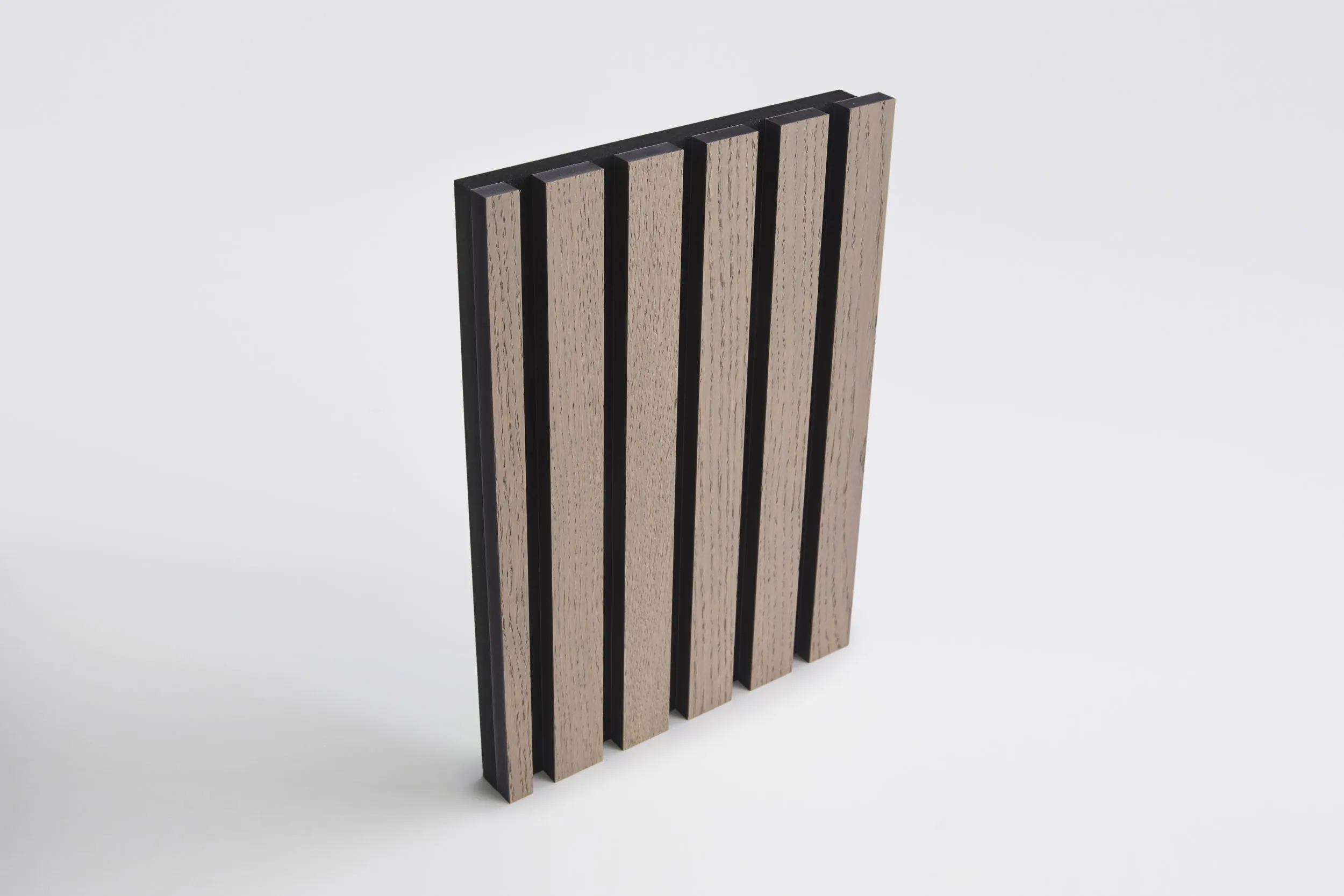
Short answer: our PET felt and wood acoustic panels sit in the same absorption band (rWood Groove and rWood Micro αw 0.90, class A; the 12 mm rPET Panel αw 0.80 to 1.00 depending on its mounting), so you choose on look, fire class, budget and sustainability story, not on acoustics. PET felt is the pick for colour, custom graphics, tight budgets and cutting on site; wood for warmth, front-of-house spaces and, on the fire-retardant MDF core, the same B-s1,d0 fire class as rPET in white, grey and black.
How PET felt and wood absorb sound
PET felt is a dense fibre board pressed from recycled PET. Sound enters the fibres and loses its energy there as friction, so the whole panel absorbs: face, edges and back. A backing air gap improves low-frequency absorption further.
Wood acoustic panels are a real wood veneer on a core. A closed veneer reflects sound, so the surface has to be opened: grooves (rWood Groove), perforations (rWood Perf) or micro-perforations (rWood Micro) let sound through the face into the absorbent layer behind it. The wood is the face; the absorber does the work.
Both reach the same class: rWood Groove and rWood Micro are αw 0.90, class A. Groove carries its own 3 mm recycled-PET felt on the back, goes on battens or glue, and the cavity behind it can take an extra absorber (acoustic felt, an rPET panel or mineral wool); Micro is clipped on rails with a cavity behind it and climbs to αw 1.00 with 50 mm mineral wool. PET felt absorbs by itself, but how much depends on the mounting: the 12 mm rPET Panel measures αw 0.25 directly on the wall, 0.80 on a 100 mm air cavity and 1.00 on a 50 mm cavity with 50 mm stone wool.
Performance side by side
| rPET Panel 12 mm | rWood Groove | rWood Micro | |
|---|---|---|---|
| Sound absorption αw (ISO 11654) | 0.80 on a 100 mm air cavity; 1.00 on a 50 mm cavity with 50 mm stone wool | 0.90 | 0.90; up to 1.00 with 50 mm mineral wool |
| NRC (ASTM C423) | 0.80 and 0.95 for the same two mountings | not published | not published |
| Absorption class (ISO 11654) | B / A | A | A |
| Fire class (EN 13501-1) | B-s1,d0 in white, grey and black; B-s2,d0 in the other colours | B-s1,d0 on the FR MDF core; D-s2,d2 on standard MDF | B-s1,d0 on the FR MDF core |
rPET Groove, cut from the same sheet, is published as NRC only: 0.55 / 0.75 / 0.90 at 12 / 24 / 36 mm; calculate with the rPET Panel figures and their mounting.
Class B (αw 0.80–0.85) is the workhorse for offices, schools and restaurants; Class A (αw 0.90 and above) is where rWood Groove, rWood Micro and our textile range Interior (αw 1.0) sit, and where the rPET Panel lands on a cavity with stone wool. Which value a room needs depends on the rules that apply: ISO 22955 for open-plan offices and, for UK readers, BB93 for schools and BS 8233 for buildings in general; check the exact requirement with your acoustician.
The maths is the same for both materials. Take a meeting room of 5 × 4 m, 2.8 m high, so V = 56 m³, measured at 0.9 s and aiming for 0.6 s for intelligible video calls. Sabine's formula A = 0.161 × V / T:
- A today = 0.161 × 56 / 0.9 = 10.0 m² Sabine
- A target = 0.161 × 56 / 0.6 = 15.0 m² Sabine
- To add: 15.0 − 10.0 = 5.0 m² Sabine
With the 12 mm rPET Panel on a 100 mm air cavity (αw 0.80) that is 5.0 / 0.80 = 6.3 m²: two panels of 2,800 × 1,220 mm (2 × 3.42 = 6.84 m²). With rWood Groove (αw 0.90) it is 5.0 / 0.90 = 5.6 m², and with the rPET Panel on a 50 mm cavity with 50 mm stone wool (αw 1.00) 5.0 m². The material changes the look and the invoice far more than it changes the number of panels.
Look and interior
PET is colour. rPET Groove comes in the ten rPET stock colours (any colour to order), in 12, 24 or 36 mm, and rPET panels can be painted or UV-printed in-house with your own graphics: a coloured wall, a logo in the felt. rPET Flex Groove follows columns and curved walls.
Wood is warmth. rWood Groove and rWood Perf show the veneer through their pattern; rWood Veneer offers a choice of FSC-certified veneers; rWood Micro has an almost closed surface that reads as a plain wood panel. In boardrooms, reception areas, restaurants and lecture theatres, wood nearly always wins on presence.
Often the answer is not either/or: wood on the feature wall, PET on the long walls and the ceiling.
Fire safety and emissions
In public buildings the EN 13501-1 reaction-to-fire class is often a hard requirement; check the exact requirement with your acoustician or fire engineer.
- rPET range: B-s1,d0 in white, grey and black, B-s2,d0 in the other colours; the class follows the colour, Standard and FR version alike. B-s1,d0 means limited combustibility, low smoke production and no flaming droplets.
- rWood Micro and rWood Perf: B-s1,d0 on the fire-retardant MDF core.
- rWood Groove: B-s1,d0 on the FR MDF core, D-s2,d2 on standard MDF, so name the core in the specification.
Indoor air: rPET is OEKO-TEX Standard 100 certified. For rWood we work with FSC-certified veneers only.
Sustainability: recycled versus renewable
rPET starts life as recycled PET; rPET Groove is made entirely from recycled PET. At end of life we take the panels back free of charge in Belgium, the Netherlands, France, Germany and Luxembourg.
rWood puts a renewable raw material on the face: only FSC-certified veneers, no exceptions. The same free take-back applies in the same five countries.
Both are made in our own plant in Częstochowa; more on our sustainability page. Selecting on one figure? PET. On a natural, certified surface? Wood.
Workability, mounting and maintenance
PET works like a board material. rPET can be cut with a knife, a circular saw, a panel saw or an angle grinder with a metal blade, and it can be painted. Joiners and fit-out contractors like it for bespoke work, trimmed around sockets and skirting. Mounting is by adhesive, Z-clips, screws or battens.
Wood asks for precision. Every cut through a veneer is visible, so plan the layout and cut list in advance rather than trimming on site. rWood Groove is tongue-and-groove, fixed on battens or glued to the substrate; rWood Micro and rWood Perf hang on a concealed clip system on rails, tool-free and demountable. Veneer is more sensitive to knocks and moisture than felt.
Maintenance: PET is vacuumed, with stains treated locally; wood is dusted and treated like furniture.
Price and lead times
Per square metre, PET felt is the more economical of the two and veneered wood the premium product; ask for a quote with your surface area. Prices are excl. VAT; transport outside Belgium, including to the UK, is quoted separately. Lead times from our own production:
- rPET Groove: about 3–4 working weeks; made-to-order colours on request.
- rWood Groove: subject to stock, confirmed on order.
- rWood Micro and rWood Perf: stock veneers in 3–4 weeks; non-stock veneers 6–8 weeks.
Re-Sound is a Stretch Group brand. We manufacture in our own plants in Beveren-Waas (Belgium) and Częstochowa (Poland). rPET and rWood come from Częstochowa; the textile range from Beveren-Waas, where you can see both materials in the showroom by appointment. See where to buy or use the contact page.
Decision table: when PET, when wood
| Your situation | Choose |
|---|---|
| Colour, graphics, logos, custom UV print | rPET Groove / rPET Panel |
| Curved walls and columns | rPET Flex Groove |
| Cutting and fitting on site, bespoke joinery | rPET Panel |
| B-s1,d0 fire class required in a public building | rPET in white, grey or black, or rWood on the FR MDF core |
| Boardroom, reception, restaurant, timber interior | rWood Groove / rWood Veneer |
| Highest recycled content | rPET (made entirely from recycled PET) |
| Renewable, certified raw material on the face | rWood (FSC veneers only) |
| Fastest delivery | rPET Groove in stock colours, or rWood Micro / Perf in stock veneers (about 3–4 weeks) |
Still undecided? Request the free sample kit and compare both materials in the room itself. The calls that still disturb the floor once the panels are up are a job for an office phone booth, not for more felt.
Frequently asked questions
Does wood absorb less sound than PET felt? Not in our ranges. rWood Groove and rWood Micro are both αw 0.90, class A to ISO 11654, and Micro climbs to 1.00 with 50 mm mineral wool in the cavity. The 12 mm rPET Panel spans the same band depending on its mounting: αw 0.80 (class B) on a 100 mm air cavity, 1.00 (class A) on a 50 mm cavity with 50 mm stone wool. The choice comes down to look, fire class, budget and sustainability story, not to absorption.
Can I combine PET and wood acoustic panels? Yes, and often it is the best answer: wood on the feature wall, PET felt on the long walls and ceiling. rPET goes up with adhesive, Z-clips, screws or battens, rWood Groove on battens or glued, rWood Micro on concealed clips; an rPET panel can even fill the cavity behind rWood Groove as an extra absorber. We take both back free of charge in BE, NL, FR, DE and LU.
Which panel is the more sustainable choice? rPET Groove is made entirely from recycled PET and is OEKO-TEX Standard 100 certified; rWood uses only FSC-certified veneers. Both are made in our own plant in Częstochowa and taken back free of charge in BE, NL, FR, DE and LU. Recycled content: rPET. Renewable surface: rWood.
Sources: ISO 11654 (sound absorption classes); ASTM C423 (NRC); EN 13501-1 (reaction-to-fire classification); ISO 22955, BB93 and BS 8233 as pointers; W.C. Sabine (reverberation formula); OEKO-TEX Standard 100; FSC; Re-Sound product data and test reports for rPET and rWood.