Specifying acoustic panels for architects: αw, NRC and Class A
Acoustic panel specification for architects: αw (ISO 11654) vs NRC (ASTM C423), Class A/B/C, mounting, fire class B-s1,d0, documents and a checklist.
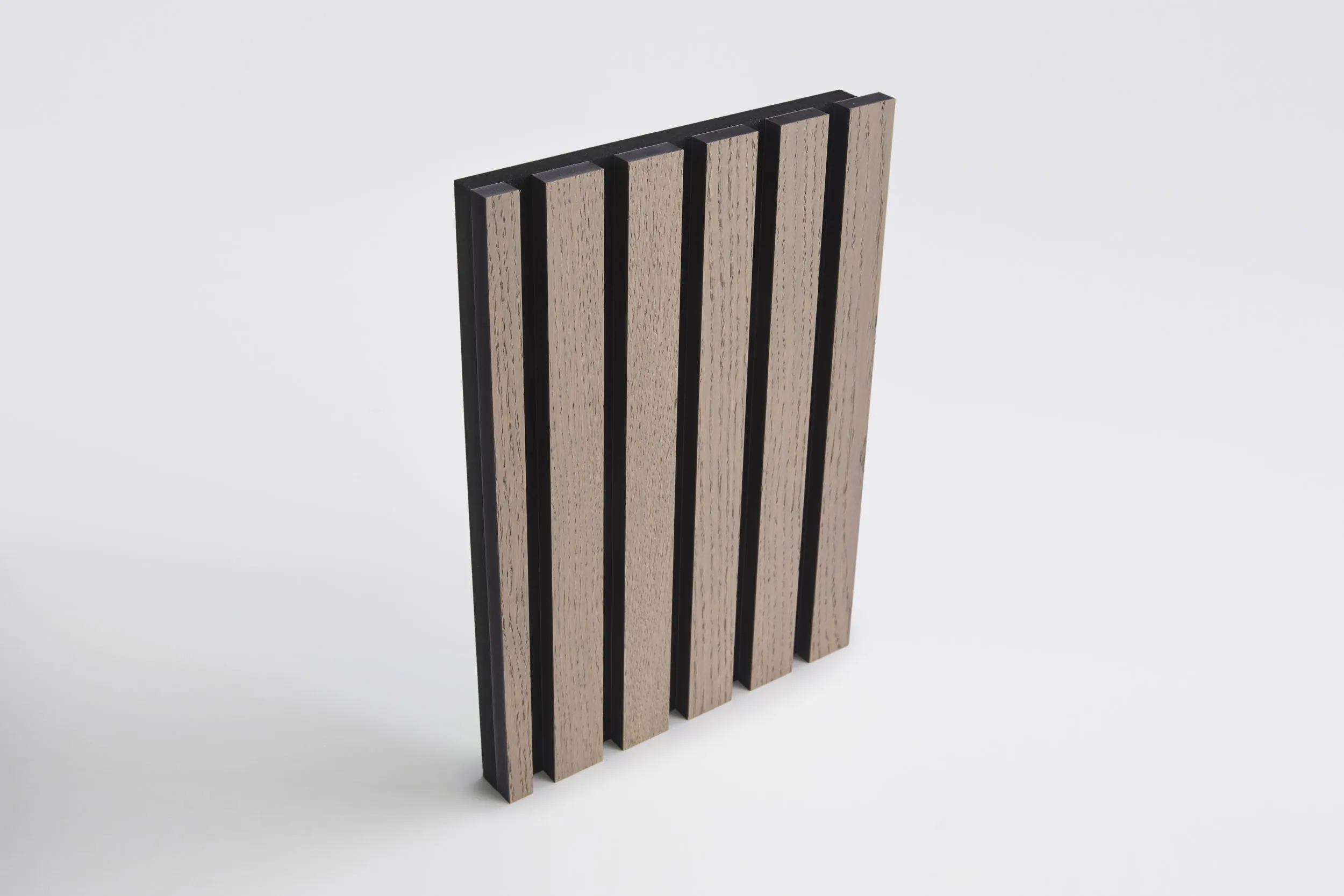
Short answer: specify an acoustic panel by one absorption rating with its standard and mounting condition (αw and class to ISO 11654, or NRC to ASTM C423), plus the EN 13501-1 fire class, certificates, recycled content, take-back and the documents to be submitted; never convert one rating into the other. Below: what the figures mean, why mounting matters, and a clause and checklist to paste.
αw and NRC: two ratings for one panel
Both come from the same kind of laboratory test: a large sample in a reverberation room, sound decay measured with and without it, an absorption coefficient α per frequency band from 0 (reflects everything) to 1 (absorbs everything).
αw (ISO 11654) fits the measured curve from 250 Hz to 4,000 Hz to a reference curve shifted in steps of 0.05. A panel weak in one band is penalised; the result is capped at 1.00 and sorted into classes A to E.
NRC (ASTM C423) averages the coefficients at 250, 500, 1,000 and 2,000 Hz, rounded to 0.05. An average forgives a weak band, and edge effects in the lab can push NRC above 1.00.
They are not interchangeable: rWood Perf in the PD8 pattern is αw 0.85 and NRC 0.90; the 12 mm rPET Panel is αw 1.00 and NRC 0.95 on a 50 mm cavity with 50 mm stone wool, αw 0.80 and NRC 0.80 on a 100 mm air cavity. Some products publish only one: rWood Groove has αw 0.90 and no NRC, rPET Groove NRC only (0.55, 0.75 and 0.90 at 12, 24 and 36 mm). Specify one, name its standard, and never convert.
What Class A, B and C mean
ISO 11654 sorts αw into five classes:
- Class A: αw 0.90–1.00
- Class B: αw 0.80–0.85
- Class C: αw 0.60–0.75
The class is shorthand, not a requirement. Which one a room needs depends on volume, target reverberation time and the standard applied: ISO 22955 for open-plan offices, ISO 3382-3 for speech decay across an open floor, and for UK projects BB93 (schools) and BS 8233; check the exact requirement with your acoustician. Our textile panels Interior, Solid and Divide are αw 1.0, Class A; rWood Groove and rWood Micro are αw 0.90, Class A; the 12 mm rPET Panel is Class B (αw 0.80) on a 100 mm air cavity and Class A (αw 1.00) on a 50 mm cavity with 50 mm stone wool.
Mounting conditions: type A versus an air gap
The test report states how the sample was mounted, and the rating only holds for that mounting.
- Type A: the panel sits directly on the hard surface, as when glued or clipped flat to a wall.
- Air gap: tested off the surface, on battens or as a ceiling; a backing air gap improves low-frequency absorption, so the same panel scores higher. The 12 mm rPET Panel shows the spread: αw 0.25 (Class D) directly on the wall, 0.60 (Class C) on a 50 mm air cavity, 0.80 (Class B) on a 100 mm air cavity, 1.00 (Class A) on a 50 mm cavity with 50 mm stone wool and 0.95 (Class A) on a 100 mm cavity with 100 mm stone wool.
An air-gap value will not be reproduced by a panel glued to plasterboard, so the clause must carry value and condition together. Wood acoustic panels add a second condition: rWood Groove (αw 0.90, Class A) carries its own 3 mm felt backing, goes on battens or glue, and the cavity behind it can take an extra absorber (acoustic felt, an rPET panel or mineral wool); rWood Micro (αw 0.90, Class A) hangs on clips with a cavity behind it and reaches αw 1.00 with 50 mm mineral wool, so specify the cavity and what fills it.
Why lab conditions matter: a worked example
Lab values come from a large, evenly mounted sample in a diffuse field; in a room the panels cover a fraction of the surface, so the rating is a basis for calculation, not a guarantee. Meeting room 5 × 4 m, 2.8 m high, V = 56 m³, measured at 0.9 s, target 0.6 s. Sabine's formula A = 0.161 × V / T:
- A today = 0.161 × 56 / 0.9 = 10.0 m² Sabine
- A target = 0.161 × 56 / 0.6 = 15.0 m² Sabine
- To add: 15.0 − 10.0 = 5.0 m² Sabine
At αw 0.80 (the 12 mm rPET Panel on a 100 mm air cavity, Class B) that is 5.0 / 0.80 = 6.3 m²: two panels of 2,800 × 1,220 mm (2 × 3.42 = 6.84 m²). At αw 1.0 (Interior, or the same rPET Panel on a 50 mm cavity with 50 mm stone wool), 5.0 / 1.0 = 5.0 m². Substitute Class B for Class A without recalculating and the room gets 5.0 × 0.80 = 4.0 m² Sabine, a 20% shortfall; glue the same 5.0 m² flat to the wall (αw 0.25) and it gets 1.25 m² Sabine, a quarter of what was specified.
Fire, emissions and circularity
Reaction to fire, EN 13501-1. B-s1,d0 means limited contribution to fire, little smoke (s1) and no flaming droplets (d0). Our rPET range is B-s1,d0 in white, grey and black and B-s2,d0 in the other colours (the class follows the colour, Standard and FR version alike); rWood Micro and rWood Perf are B-s1,d0 on the fire-retardant MDF core, rWood Groove B-s1,d0 on the FR core and D-s2,d2 on the standard core — take the class from the datasheet for the chosen build. Check the exact requirement with your acoustician or fire engineer.
Emissions and materials. For felt, ask for OEKO-TEX Standard 100; our rPET carries it. For wood, ask for FSC on the veneer; rWood uses FSC-certified veneers only.
Recycled content and take-back. State the minimum recycled content and the end-of-life route. rPET Groove is made entirely from recycled PET, and all our panels are taken back free of charge in Belgium, the Netherlands, France, Germany and Luxembourg (see sustainability). Re-Sound is a Stretch Group brand. We manufacture in our own plants in Beveren-Waas (Belgium) and Częstochowa (Poland).
Re-Sound ranges as worked examples
| rPET Panel 12 mm | rWood Groove | rWood Micro | Interior / Solid / Divide | |
|---|---|---|---|---|
| αw (ISO 11654) | 0.80, Class B on a 100 mm air cavity; 1.00, Class A on a 50 mm cavity with 50 mm stone wool | 0.90, Class A | 0.90, Class A; up to 1.00 with 50 mm mineral wool | 1.0, Class A |
| NRC (ASTM C423) | 0.80 and 0.95 for the same two mountings | not published | not published | see test report |
| Fire (EN 13501-1) | B-s1,d0 in white, grey and black; B-s2,d0 in the other colours | B-s1,d0 on the FR MDF core; D-s2,d2 on standard MDF | B-s1,d0 on the FR MDF core | see datasheet |
Interior starts at €387 per set excl. VAT; felt and wood panels are quoted per m² excl. VAT, transport outside Belgium extra. Office phone booths are rated to ISO 23351-1 speech-level reduction instead: Solo Flex (about 24 dB(A)) and Modular XL (25.9 dB(A)) are Class C there; check the exact requirement with your acoustician.
What to put in the specification clause
Example clause for a felt wall panel, Class A or Class B depending on the cavity:
Acoustic wall panel, PET felt made entirely from recycled PET, 12 mm, 2,800 × 1,220 mm, from ten stock colours. αw 1.00, Class A to ISO 11654 on a 50 mm cavity with 50 mm stone wool [or: αw 0.80, Class B on a 100 mm air cavity], in the mounting condition of the test report, matching the installed condition [cavity of … mm / absorber …]. Fire class B-s1,d0 (white, grey, black) or B-s2,d0 (other colours) to EN 13501-1. OEKO-TEX Standard 100. Fixed with screws or adhesive; manufacturer take-back at end of life. Submit: datasheet, test report to the specified standard, EN 13501-1 classification report, certificates and installation guide. Reference: Re-Sound rPET Panel, or equal approved on the same documents.
For a textile panel, swap in Interior, Solid or Divide (αw 1.0, Class A); for a wood feature wall, rWood Groove or rWood Micro (αw 0.90, Class A), naming the MDF core for the fire class and, for rWood Micro, the cavity and its mineral wool.
Specification checklist
| Item | Write |
|---|---|
| Absorption rating | αw and class (ISO 11654) or NRC (ASTM C423), never converted |
| Mounting condition | Type A, air cavity or cavity with absorber, as tested and as drawn |
| Thickness, format, finish | e.g. 12 mm, 2,800 × 1,220 mm, colour or veneer |
| Fire class | EN 13501-1, e.g. B-s1,d0 |
| Certificates and circularity | OEKO-TEX Standard 100, FSC, recycled content, take-back |
| Quantity | Sabine, A = 0.161 × V / T, at the specified αw |
| Documents | Datasheet, test report, fire report, certificates, installation guide |
Send us the room schedule for datasheets, test reports and a quote per range, or start with the free sample kit. See where to buy or contact us.
Frequently asked questions
Is αw the same as NRC? No. αw (ISO 11654) fits the measured curve from 250 to 4,000 Hz to a reference curve in 0.05 steps, capped at 1.00; NRC (ASTM C423) averages the coefficients at 250, 500, 1,000 and 2,000 Hz. rWood Perf in the PD8 pattern is αw 0.85 but NRC 0.90. Specify one, name its standard, never convert.
What does Class A mean for an acoustic panel? Class A is the top band of ISO 11654, αw 0.90 to 1.00; Class B is 0.80 to 0.85, Class C 0.60 to 0.75. Interior, Solid and Divide are αw 1.0, Class A, and so are rWood Groove and rWood Micro at αw 0.90; the 12 mm rPET Panel is Class B (αw 0.80) on a 100 mm air cavity and Class A (αw 1.00) on a 50 mm cavity with 50 mm stone wool. Which class a room needs depends on the standard applied; check the exact requirement with your acoustician.
Which documents should the specification ask for? The datasheet, the test report stating the mounting condition, the EN 13501-1 classification report, the OEKO-TEX Standard 100 or FSC certificate, a recycled content and take-back statement, and the installation guide. Write "or equal approved" only if a substitute must submit the same set.
Sources: ISO 11654 (αw and classes); ASTM C423 (NRC); EN 13501-1 (reaction to fire); ISO 22955, ISO 3382-3, BB93 and BS 8233 as pointers; ISO 23351-1 (phone booths); W.C. Sabine; OEKO-TEX Standard 100; FSC; Re-Sound product data and test reports.