Recycled PET acoustic panels: benefits, fixing and price
Recycled PET acoustic panels: αw by mounting, fire class by colour, OEKO-TEX, cutting and UV print, clips or adhesive, lead time and price against wood.
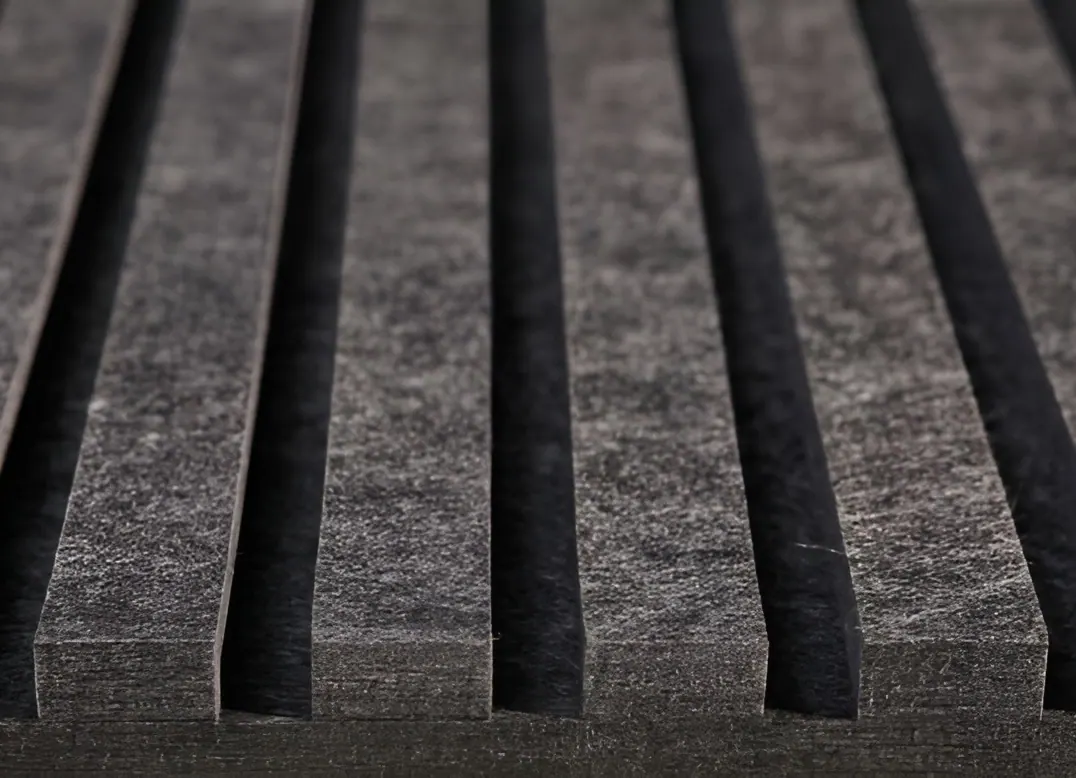
A recycled PET acoustic panel is a dense felt board pressed from used drinks bottles. It soaks up speech (the 12 mm rPET Panel reaches αw 0.80, class B to ISO 11654, on a 100 mm air cavity and αw 1.00, class A, over a 50 mm cavity filled with 50 mm stone wool), cuts and paints like a joinery board, takes UV print and goes up with clips or adhesive, at a price per square metre below veneered wood. Here is the fact sheet of our rPET range, from raw material to the comparison with wood.
What is a recycled PET acoustic panel?
PET is the plastic of water and soft-drink bottles. Once collected, the bottles are sorted, washed and shredded; the flakes are melted into fibre and pressed under heat into a dense board, and that board is PET felt. Our rPET range is made entirely from recycled PET, and the fibre does three jobs at once: it carries itself, it is the visible face and it is the absorber. No fabric, no veneer.
Re-Sound makes two families from it. rPET Groove is the grooved version, cut from the sheet: ten stock colours and any other colour to order, widths of 600 and 1,200 mm, thicknesses of 12, 24 and 36 mm. rPET Panel is the plain, solid sheet in 9 and 12 mm, in formats of 2,800 × 1,220 and 2,440 × 1,220 mm; its absorption depends on the mounting, as the table below shows. Where a wall curves or a column needs wrapping, rPET Flex Groove bends to a minimum radius of 500 mm thanks to its V-cut grooves.
How PET felt absorbs sound
Sound enters the felt, sets the fibres moving and loses its energy there as friction. The entire panel takes part, edges and back included. The measured figures for the rPET range:
| Product and mounting | αw (ISO 11654) | Class | NRC (ASTM C423) |
|---|---|---|---|
| rPET Panel 12 mm, fixed directly to the wall | 0.25 | D | 0.40 |
| rPET Panel 12 mm, 50 mm air cavity | 0.60 | C | 0.75 |
| rPET Panel 12 mm, 100 mm air cavity | 0.80 | B | 0.80 |
| rPET Panel 12 mm, 50 mm cavity filled with 50 mm stone wool | 1.00 | A | 0.95 |
| rPET Groove, 12 / 24 / 36 mm | not published | – | 0.55 / 0.75 / 0.90 |
The 9 mm sheet is not yet measured (EN ISO 354, 12 mm sheet), and a cavity behind the panel, filled or not, does more for the low frequencies than the thickness of the felt.
Class A (αw 0.90 or more) comes from the rPET Panel over a filled 50 mm cavity (αw 1.00) or from our textile range Interior (αw 1.0). In most offices, schools and restaurants class B is plenty; area, mounting and placement matter more than the step from 0.80 to 1.00. Which reverberation time a room needs depends on its use: ISO 22955 for open-plan offices and, for UK projects, BB93 for schools and BS 8233 for buildings in general. Check the exact requirement with your acoustician.
How many m² do you need? A Sabine example
Take a classroom of 8 × 7 m with a 3.2 m ceiling, so 179 m³, with a tiled floor, a plasterboard ceiling and one glazed wall. Measured reverberation time: 1.2 s. As a reference for the target we borrow the method of the German standard DIN 18041, which puts teaching and meeting rooms in its group A3 (teaching/communication) and sets T = 0.32 · lg(V) − 0.17 s:
T = 0.32 × lg(179) − 0.17 = 0.32 × 2.25 − 0.17 = 0.72 − 0.17 = 0.55 s
Check the exact requirement with your acoustician. Sabine's formula, A = 0.161 × V / T, then tells you how much absorption to add:
| Step | Calculation | Result |
|---|---|---|
| Absorption in the room today | 0.161 × 179 ÷ 1.2 | 24.0 m² Sabine |
| Absorption at the target | 0.161 × 179 ÷ 0.55 | 52.4 m² Sabine |
| To add | 52.4 − 24.0 | 28.4 m² Sabine |
Solving that entirely with the 12 mm rPET Panel on a 100 mm air cavity (αw 0.80, class B) would take 28.4 ÷ 0.80 = 35.5 m² of panel, eleven sheets of 2,800 × 1,220 mm (11 × 3.42 = 37.6 m²). A combination is more practical: 30 m² of class A ceiling (assume αw 0.9, for instance an acoustic stretch ceiling from our sister company STRETCH) gives 30 × 0.9 = 27.0 m² Sabine, and two rPET Panels on a 100 mm air cavity on the back wall add 6.84 m² × 0.80 = 5.5 m² Sabine. Together 32.5 m² Sabine, above the 28.4 required; the room lands at 0.161 × 179 ÷ (24.0 + 32.5) = 0.51 s.
Panels take the reverberation out of a room; they do not stop the phone call carrying across an open-plan floor. That is a job for an acoustic phone booth such as Solo Flex: from €4,118.75 excl. VAT without installation, installation by our own team €1,245, transport within mainland Europe €500, each excl. VAT.
Fire safety and emissions: B-s1,d0 and OEKO-TEX
In schools and public buildings the reaction-to-fire class to EN 13501-1 is usually a hard requirement. For the rPET range the classification follows the colour: white, grey and black are B-s1,d0 (limited contribution to fire, little smoke, s1, no flaming droplets, d0); every other colour is B-s2,d0, Standard and FR versions alike. Classification reports on request. Which class your project must meet depends on the building and its use; check the exact requirement with your acoustician and your fire engineer.
For indoor air, the rPET felt is certified to OEKO-TEX® Standard 100, the test scheme that screens textiles for harmful substances.
Cutting, painting, UV printing and fixing
On site an rPET panel cuts with a knife, a circular saw, a panel saw or an angle grinder with a metal-cutting blade; a joiner builds it into cupboards, counters or partitions and trims cut-outs on the spot.
The felt can be painted when you need an exact house colour. And Re-Sound UV-prints rPET panels in-house: logos, wayfinding, artwork, quoted per job.
Two ways to fix it:
- With clips: the panel comes off again and can be reused, ideal for rented offices and for take-back later.
- Glued: for a permanent installation on a flat, clean, load-bearing substrate. Screws or battens work too.
At the end of its life the take-back is free in Belgium, the Netherlands, France, Germany and Luxembourg only; read more under sustainability.
Lead time and price: where PET stands against wood
Lead times ex works:
- rPET Groove and rPET Panel: about 3–4 working weeks; made-to-order colours on request.
- rWood Micro: 3–4 weeks for stock veneers, 6–8 weeks for veneers outside the stock programme.
- rWood Groove: subject to stock; we confirm the lead time on order.
Behind Re-Sound stands Stretch Group, with its own production in Beveren-Waas (Belgium) and Częstochowa (Poland). The rPET panels come out of the Polish plant.
The price per m² depends on thickness, colour, print and quantity and is set by quotation, excl. VAT. For the same area, recycled PET sits clearly below veneered wood. For orientation, our textile range Interior starts at €387 excl. VAT per set. Send us your square metres, or call in at a dealer near you.
PET or wood: comparison and decision table
| Criterion | rPET | rWood |
|---|---|---|
| Absorption αw (ISO 11654) | rPET Panel 12 mm: 0.80 (B) on a 100 mm air cavity; 1.00 (A) over a filled 50 mm cavity | rWood Groove 0.90 (A); rWood Micro 0.90 (A), to 1.00 with 50 mm mineral wool |
| NRC (ASTM C423) | rPET Groove: 0.55 / 0.75 / 0.90 at 12 / 24 / 36 mm | not published |
| Reaction to fire (EN 13501-1) | white, grey and black B-s1,d0; other colours B-s2,d0 | rWood Groove: B-s1,d0 on the FR MDF core, D-s2,d2 on standard MDF; rWood Micro: B-s1,d0 (FR MDF core) |
| Material | made entirely from recycled PET, OEKO-TEX® Standard 100 | FSC-certified veneers only |
| Finish | ten stock colours, any colour to order, paintable, UV print | veneer species |
| Working on site | knife, saw, angle grinder | plan ahead (veneer) |
| Price per m² | on quotation; below wood | on quotation; premium |
And as a quick decision:
| Your situation | Recommendation |
|---|---|
| Colour, graphics, logo, wayfinding | rPET Groove / rPET Panel |
| Fitting into cupboards, counters, partitions yourself | rPET Panel |
| Curved walls and columns | rPET Flex Groove |
| B-s1,d0 in a school or public building | rPET in white, grey or black, rWood Micro or rWood Groove on the FR MDF core |
| Front-of-house space, reception, timber furniture | rWood Groove / rWood Micro |
| Highest recycled content | rPET (made entirely from recycled PET) |
| Class A required | rPET Panel over a filled 50 mm cavity (αw 1.00), rWood Groove / rWood Micro (αw 0.90) or Interior (αw 1.0) |
| Short lead time, large area, tight budget | rPET |
The answer is often both: wood on the wall people look at, PET everywhere else. Browse our wood acoustic panels, read the full comparison in PET acoustic panels vs wood, then request the rPET sample kit or a quote per m² via contact.
Frequently asked questions
Does a recycled PET panel absorb as well as a wood panel? Yes, provided the mounting is right. The 12 mm rPET Panel reaches αw 0.80 (class B to ISO 11654) on a 100 mm air cavity and 1.00 (class A) over a 50 mm cavity filled with 50 mm stone wool; rPET Groove is rated by NRC, 0.55 / 0.75 / 0.90 at 12 / 24 / 36 mm. rWood Groove and rWood Micro both sit at αw 0.90 (class A), Micro rising to 1.00 with 50 mm mineral wool. The difference is build-up, look, budget and lead time, not the material.
Which thickness should I choose: 12, 24 or 36 mm? For rPET Groove the absorption climbs with thickness: NRC 0.55 at 12 mm, 0.75 at 24 mm, 0.90 at 36 mm. For the plain 12 mm rPET Panel the mounting decides, from αw 0.25 (class D) flat on the wall to 1.00 (class A) over a filled 50 mm cavity; 12 mm is the choice where space is tight or the panel is built into furniture. Which reverberation time your room must reach is a question for your acoustician.
How are PET panels fixed, and can they be printed? With clips (demountable, handy in rented premises) or glued for a permanent installation. On site you cut the felt with a knife, a circular saw, a panel saw or an angle grinder; it can be painted, and Re-Sound UV-prints rPET panels in-house, so logos, wayfinding and artwork are all possible. Delivery takes about 3–4 working weeks.
Sources: ISO 11654 (sound absorption classes); EN ISO 354 (measurement); ASTM C423 (NRC); EN 13501-1 (reaction to fire); OEKO-TEX® Standard 100; FSC; W.C. Sabine (reverberation formula); DIN 18041 (German reference method for the target reverberation time); ISO 22955 (open-plan offices); BB93 and BS 8233 (UK pointers); Re-Sound rPET and rWood datasheets and test reports.