Acoustic panels for restaurants: less noise, longer tables
Restaurant too loud? Which reverberation time suits your concept, where panels pay back most, fire classes for hospitality and a worked example for 100 m².
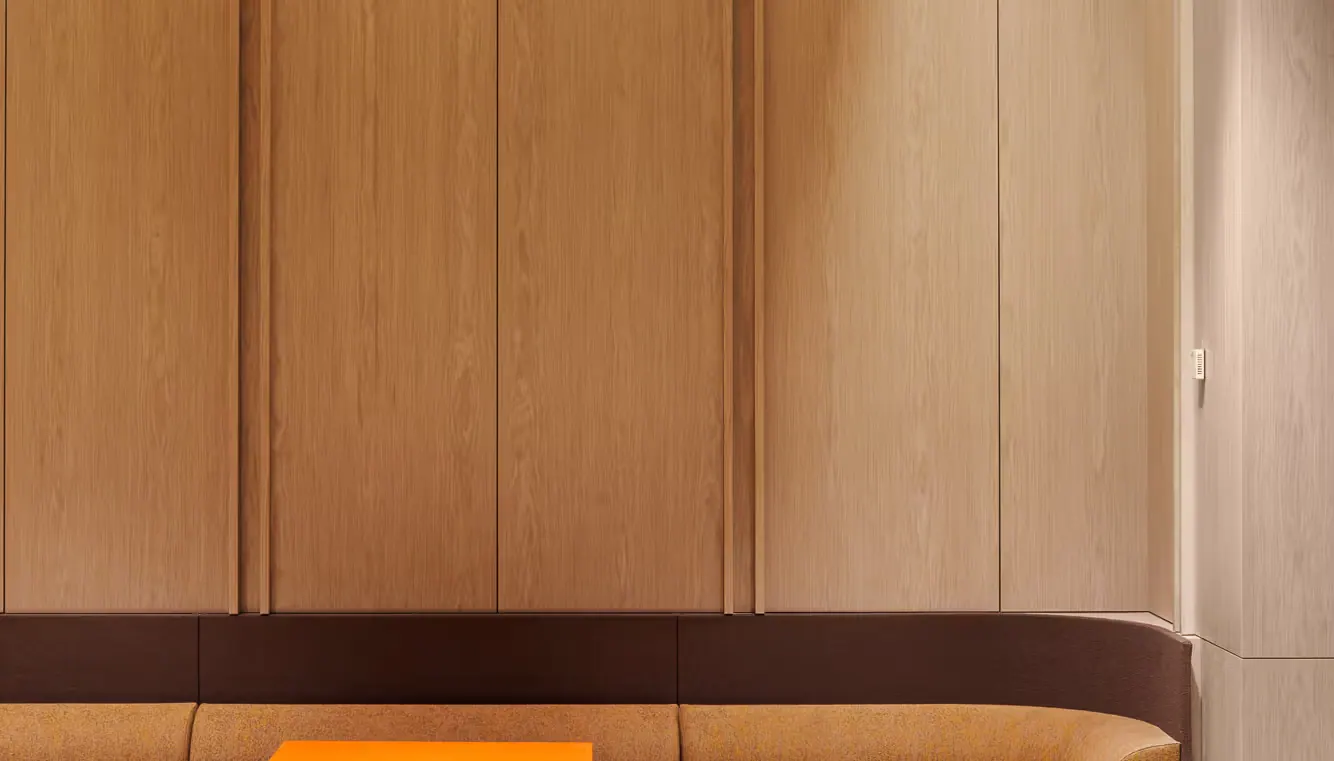
In a restaurant with a reverberation time above 1 second, guests talk louder, stay shorter and mention it in their review. Acoustic panels on the ceiling and on the walls behind the banquettes bring the reverberation back to 0.6–0.8 seconds: conversations stay at the table, the atmosphere stays lively, and the room sounds full without being loud. This article explains which reverberation time suits which concept, where panels pay back most, what the fire class means for hospitality and what a 100 m² dining room needs.
The Lombard effect: why your restaurant makes itself louder
Hard floors, glass, an open kitchen and a concrete ceiling bounce every conversation around the room several times. Whoever can no longer hear their dinner companion speaks up; the next table does the same. That escalation, the Lombard effect, is why a room with forty guests on a Friday night sounds twice as loud as with twenty. It is also why "too loud" turns up so often in restaurant reviews, and why guests skip dessert and coffee after the main course. Absorption breaks the spiral: less reverberation, a lower background level, and guests talking at a normal volume again.
Which reverberation time suits which concept
There is no legal requirement for the reverberation time of a restaurant, but there is a clear practice:
| Concept | Target |
|---|---|
| Fine dining, hotel restaurant | 0.5–0.6 s |
| Brasserie, bistro | 0.6–0.8 s |
| Bar, food hall, function room | 0.8–1.0 s (lively, yet intelligible at the table) |
An untreated room with tiles and glass often measures 1.2 to 1.6 s when empty. Guests bring absorption of their own (allow 0.4 to 0.5 m² Sabine per person), so a room that reaches 0.8 s empty sits around 0.6 s when full. Design for the empty room; the full room then takes care of itself.
Ceiling first
The ceiling is the largest surface and the only one with no table, door or artwork in the way. Two routes:
- Acoustic stretch ceiling: a perforated membrane with absorption behind it, seamless up to 5 m wide, in matt colours or printed, fitted in one day without dust, ideal for a refit between two services. Our sister company STRETCH installs them; read more at stretchplafond.be.
- Ceiling panels or rafts in recycled PET where the ceiling has to stay visible, for example above an open kitchen or under a historic structure.
Rule of thumb: making 50 to 70% of the ceiling absorbent solves most of the problem; the walls do the rest.
Walls: warm wood or colour
Wall panels set the mood and break the reflections between the long walls.
- rWood Micro: micro-perforated wood veneer on a fire-retardant MDF core that reads as a sleek timber wall from two metres away. αw 0.90 (class A), fire class B-s1,d0. The choice for fine dining and hotel restaurants.
- rWood Groove: grooved oak or walnut veneer on MDF lamellas with 3 mm recycled PET felt on the back, αw 0.90 (class A). Warmth and rhythm for a brasserie or bistro.
- rPET Groove: recycled PET felt in ten stock colours and any colour to order (NRC 0.55 to 0.90 according to thickness), B-s1,d0 in white, grey and black, B-s2,d0 in the other colours, for concepts built on colour, or behind banquettes where wood would be too vulnerable.
- Interior: textile panels with a removable, washable cover (αw 1.0, class A) for zones where things get spilled.
Place wall panels at the ear height of seated guests (0.9 to 1.8 m) and above all on the wall behind the banquettes and the wall facing the bar or open kitchen: that is where most of the sound comes from and where it reflects hardest. The veneers are on the wood range page.
Between the tables
When ceiling and walls have been treated and the big tables are still loud, freestanding absorbent partitions help. Divide couples magnetically, absorbs on both sides and moves along when the room is laid out differently for a party. One Divide module between two tables of eight turns one loud group into two conversations.
Fire safety and upkeep in hospitality
Hospitality falls under strict fire rules, and the fire officer looks at wall and ceiling linings.
- Fire class (EN 13501-1): the rPET range (Panel, Groove, Flex Groove) is B-s1,d0 in white, grey and black and B-s2,d0 in the other colours (limited combustibility, little smoke, no flaming droplets); the rWood range (Groove, Micro, Perf) is B-s1,d0 on the fire-retardant MDF core. Always ask for the classification report and keep it in your fire safety file; we supply it on request. Check the exact requirement with your acoustician and your fire officer.
- Grease and moisture: no absorbent panel belongs directly above a fryer or grill. Above the open kitchen an acoustic stretch ceiling at a distance works better than panels close by.
- Cleaning: PET felt is vacuumed and spot-treated; wood is treated like a piece of furniture; the Interior covers go in the washing machine. A damaged panel is replaced individually.
- Emissions: rPET is OEKO-TEX® Standard 100 certified.
Worked example for 100 m²
Dining room of 12.5 × 8 m, 3.2 m high (320 m³), tiled floor, lots of glass, 50 covers. Measured empty: 1.4 s. Target: 0.7 s (brasserie).
Sabine's formula, A = 0.161 × V / T, gives:
- absorption present: 0.161 × 320 / 1.4 = 36.8 m² Sabine
- absorption at the target: 0.161 × 320 / 0.7 = 73.6 m² Sabine
- to add: 36.8 m² Sabine
Proposal: 35 m² of ceiling in class A (αw 0.9, so 31.5 m² Sabine) plus 8 m² of rWood Micro behind the banquettes (at αw 0.90 about 7.2 m² Sabine) = 38.7 m² Sabine. Fully booked (50 guests, roughly 22 m² Sabine extra) the room drops to about 0.5 s: fine-dining level during service, lively enough at aperitif time. The method is set out step by step in How many acoustic panels do I need?.
Phasing and budget
Not every business can close for a week. A phasing that works:
- Measure (half an hour, on a quiet morning) and tackle the ceiling: the biggest effect, in one day with a stretch ceiling.
- The wall behind the banquettes and the wall facing the bar: 8–15 m² of rWood or rPET, fitted on a closing day.
- Divide modules at the big tables as the finishing touch, with no installation.
- Measure again and use the result in your marketing: "you can hear each other" is a selling point.
Lead times from our own production: rPET in about 3–4 working weeks, rWood Micro and Perf in stock veneers in 3–4 weeks; the lead time for rWood Groove we confirm on order. At the end of their life, or when the concept changes, we take the panels back free of charge in Belgium, the Netherlands, France, Germany and Luxembourg; outside those five countries the take-back does not apply. Re-Sound is a Stretch Group brand producing in its own plants in Beveren-Waas (Belgium) and Częstochowa (Poland).
Want to hear the effect before you decide? We come to your venue with panels and a measuring kit in Belgium, the Netherlands, Luxembourg and northern France, or you visit the showroom in Beveren-Waas where every range stands installed. The free sample kit covers every finish.
Frequently asked questions
Which acoustic panels suit a restaurant? For the ceiling an acoustic stretch ceiling or PET ceiling panels; for the walls rWood Micro or Groove (wood) and rPET Groove (colour), rWood with fire class B-s1,d0 on the fire-retardant MDF core, rPET B-s1,d0 in white, grey and black and B-s2,d0 in the other colours; we supply the classification report for your fire safety file on request.
How many panels does a 100 m² restaurant need? Roughly 35 m² of absorbent ceiling plus 8–15 m² of wall panels to go from 1.4 to 0.7 s. With a measurement we work it out exactly.
Can the installation happen between two services? An acoustic stretch ceiling is fitted in one day without dust; a team fits wall panels in half a day; Divide modules need no installation at all.
Sources: ISO 3382-2 (reverberation time measurement); ISO 11654 (absorption classes); EN 13501-1 (reaction-to-fire classification); W.C. Sabine (reverberation formula); OEKO-TEX® Standard 100; Re-Sound product data and test reports.