Reverberation time in classrooms: standards, measurements and solutions
What reverberation time a classroom needs: the Belgian standard, BB93 for UK schools, how to measure, how much absorption to add, with a worked example.
In a classroom the reverberation time decides whether pupils understand the teacher and whether the teacher still has a voice at four o'clock. The Belgian standard NBN S 01-400-2 sets maximum reverberation times for school buildings; for an ordinary classroom that comes down in practice to roughly 0.6 to 0.8 seconds, a common order of magnitude across Europe, while an untreated room with plasterboard, glass and a tiled floor often sits above 1 second. In the UK, BB93 sets its own limits per room type. This article explains what the standards ask, how to measure, how much absorption you need and which solutions last ten school years.
Why reverberation in a classroom costs more than you think
Speech intelligibility drops quickly once the reverberation goes past 0.8 s: the teacher's syllables run into each other, especially at the back of the room and for pupils who speak another language at home or hear less well. The teacher compensates by speaking louder (the Lombard effect), the pupils do the same, and the room gets louder still. The outcome is familiar from research into voice complaints among teachers and from complaints about concentration in open learning environments. The remedy costs less than the complaints: add absorption on the ceiling and on the back wall.
The standards: NBN S 01-400-2 in Belgium, BB93 in the UK
NBN S 01-400-2 sets the acoustic criteria for school buildings in Belgium. It covers airborne sound insulation between rooms, impact sound, noise from building services and the reverberation time per room type. For reverberation the standard works like this:
- The requirement is a maximum nominal reverberation time that depends on room type and volume; it is assessed in the furnished, unoccupied room.
- There are two levels: normal acoustic comfort (the basic requirement) and enhanced acoustic comfort (stricter, advisable for pupils with hearing or language difficulties).
- Besides classrooms there are separate requirements for, among others, dining halls, sports halls, corridors and assembly halls, the rooms where reverberation is traditionally highest.
For a standard classroom of 180 to 250 m³ the Belgian requirement lands in practice between 0.6 and 0.8 s, and that range is a common order of magnitude elsewhere too. By way of comparison, the method of the German standard DIN 18041 sets T = 0.32·lg(V) − 0.17 for teaching rooms, which gives 0.57 s for 200 m³. In the UK, BB93 lays down its own limits per room type and BS 8233 covers sound in buildings in general. Have the exact requirement for your room worked out by the architect or acoustician: the volume and the use set the figure. What no standard does is tell you which material to use; that remains the school's choice.
How to measure reverberation time (and what you miss if you don't)
A reverberation measurement to ISO 3382-2 takes half an hour per room: a short impulse or noise, a microphone at a few positions, and a reading per octave band from 125 to 4,000 Hz. What it tells you that an estimate cannot:
- Per frequency: many rooms ring mainly in the low frequencies, where thin panels do little. Then you choose thicker panels or an air cavity.
- Empty versus furnished: the standard assesses the furnished room. Cupboards, desks and curtains count, but less than one hopes.
- Before and after: a measurement before the works and one after is the proof for the school board and, in grant applications, for the funding body.
Re-Sound measures on request; for a first estimate the dimensions of the room are enough.
Worked example: from 1.2 to 0.6 seconds
Classroom of 8 × 7 m and 3.2 m high (179 m³): tiled floor, plasterboard ceiling and a glazed wall. Measured: 1.2 s. Target: 0.6 s.
Sabine's formula (A = 0.161 × V / T):
- absorption present: 0.161 × 179 ÷ 1.2 = 24 m² Sabine
- absorption at the target: 0.161 × 179 ÷ 0.6 = 48 m² Sabine
- to add: 24 m² Sabine
Proposal: 30 m² of absorbent ceiling in class A (αw 0.9), good for 27 m² Sabine, plus 6 m² of rWood Groove on the back wall (αw 0.90, 5.4 m² Sabine). Together well over 32 m² Sabine: comfortably above the 24 needed, so the room stays under 0.6 s even when empty and there is margin for the low frequencies. How to do the sum yourself is in our guide on how many acoustic panels you need.
Solutions that stand up to school life
A school is not an office: people lean against walls, drag chairs and work with wet sponges. Our recommendations per zone:
- Ceiling first. An acoustic stretch ceiling (seamless, fitted in one day by our sister company STRETCH) or ceiling panels in recycled PET take out most of the reverberation without using up wall space.
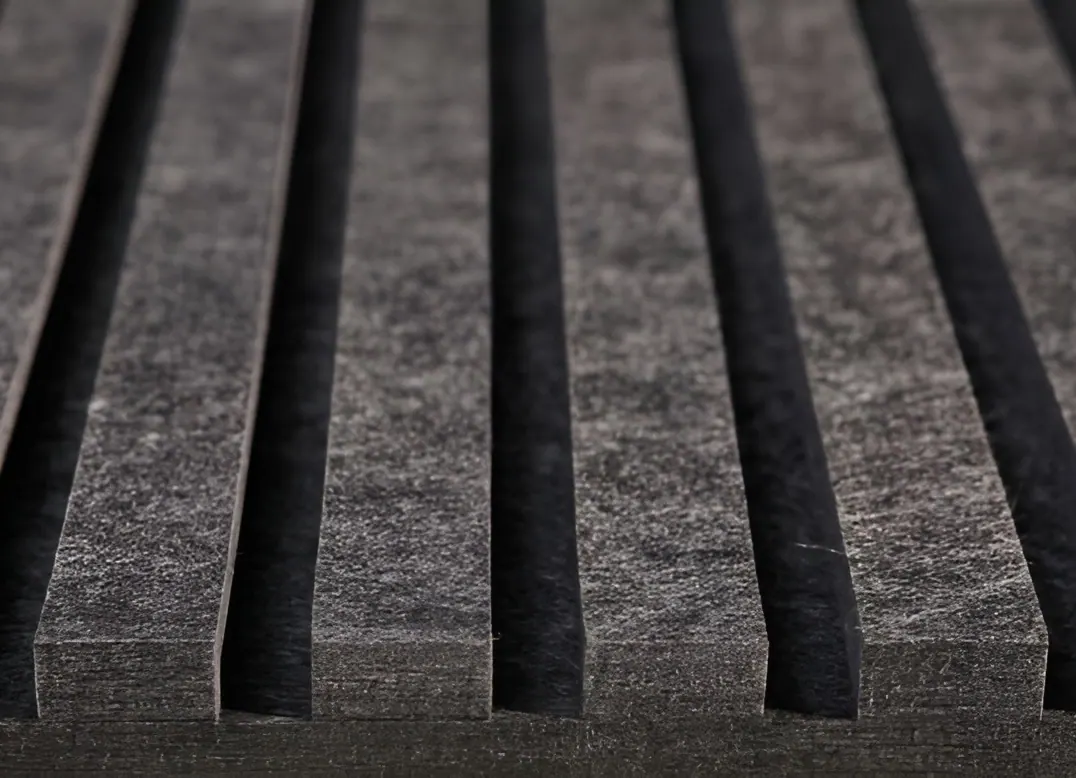
- Back wall and side wall. rPET Groove: ten stock colours and any colour to order, 12 / 24 / 36 mm (NRC 0.55 to 0.90), fire class B-s1,d0 in white, grey and black and B-s2,d0 in the other colours, worked like MDF and easy to replace panel by panel. At the pupils' ear height, not above the cupboards.
- Nursery classes and care rooms. Interior: modular textile panels (αw 1.0, class A) with a removable, washable cover.
- Dining hall, assembly hall and multi-purpose hall. rWood Micro: micro-perforated wood veneer with fire class B-s1,d0, smart enough for the hall and absorbent enough for the dining room.
- Open learning areas. Divide: freestanding partitions that couple magnetically and mark out learning zones without building walls.
Fire class, emissions and maintenance
For school buildings the fire class and indoor air quality matter as much as the acoustics:
- Fire class (EN 13501-1): every rPET product (Panel, Groove and Flex Groove) is B-s1,d0 for white, grey and black and B-s2,d0 for every other colour, meaning limited combustibility, little smoke and no flaming droplets; every rWood product (Groove, Micro and Perf) is B-s1,d0 on its fire-retardant MDF core. Check the exact requirement with your acoustician and fire officer.
- Emissions: rPET is OEKO-TEX® Standard 100 certified.
- Maintenance: PET felt is vacuumed and spot-treated where marked; the Interior covers go in the washing machine. Damaged panels are replaced one at a time, without repainting the wall.
- Origin: the veneer of every rWood product is FSC®-certified, chain-of-custody certificate C191539.
Planning: summer holidays, specification and take-back
Most schools install acoustics during the summer holidays. Count back from the first day of term:
- Measurement and proposal in spring; approval by the school board.
- Specification: for every product we supply a specification text with αw, class, fire class, format, thickness and material, so a tender can go out without a brand name.
- Order before the end of May: rPET ships in about 3–4 working weeks (custom colours on request), rWood Micro and Perf in 3–4 weeks for stock veneers and 6–8 weeks for non-stock ones, and rWood Groove on a lead time confirmed at order.
- Installation in July, measurement in August, ready for September.
At the end of their life, or during a refurbishment, the panels come back to us free of charge from Belgium, the Netherlands, France, Germany and Luxembourg (nowhere else) and the material goes back into our production. Re-Sound is a Stretch Group brand with two plants of its own, Beveren-Waas in Belgium and Częstochowa in Poland.
Ready to start? Request the free sample kit (A4 samples of every range) and the specification texts for your file via contact, or book a visit to the showroom in Beveren-Waas.
Frequently asked questions
Which reverberation time is required in a classroom? The Belgian standard NBN S 01-400-2 sets a maximum nominal reverberation time per room type and volume; for a standard classroom that comes down in practice to roughly 0.6 to 0.8 s (normal comfort), stricter for enhanced comfort. In the UK, BB93 sets its own limits per room type. Have the exact requirement calculated by your architect or acoustician.
Are wall panels alone enough in a classroom? Usually not without taking up a lot of wall area: the ceiling is the largest surface and the most efficient. Ceiling plus back wall is the combination that meets the standard in most classrooms.
How quickly can a school be fitted out? We deliver rPET in about 3–4 working weeks; a team fits an average classroom in half a day. Order before the end of May to be sure of installation in the summer holidays.
Sources: NBN S 01-400-2 (acoustic criteria for school buildings, Belgium); BB93 (acoustic design of schools, UK); BS 8233 (UK pointer); DIN 18041 (German reference method); ISO 3382-2 (measuring reverberation time); ISO 11654 (absorption classes); EN 13501-1 (fire classification); FSC; OEKO-TEX® Standard 100; Re-Sound product data.